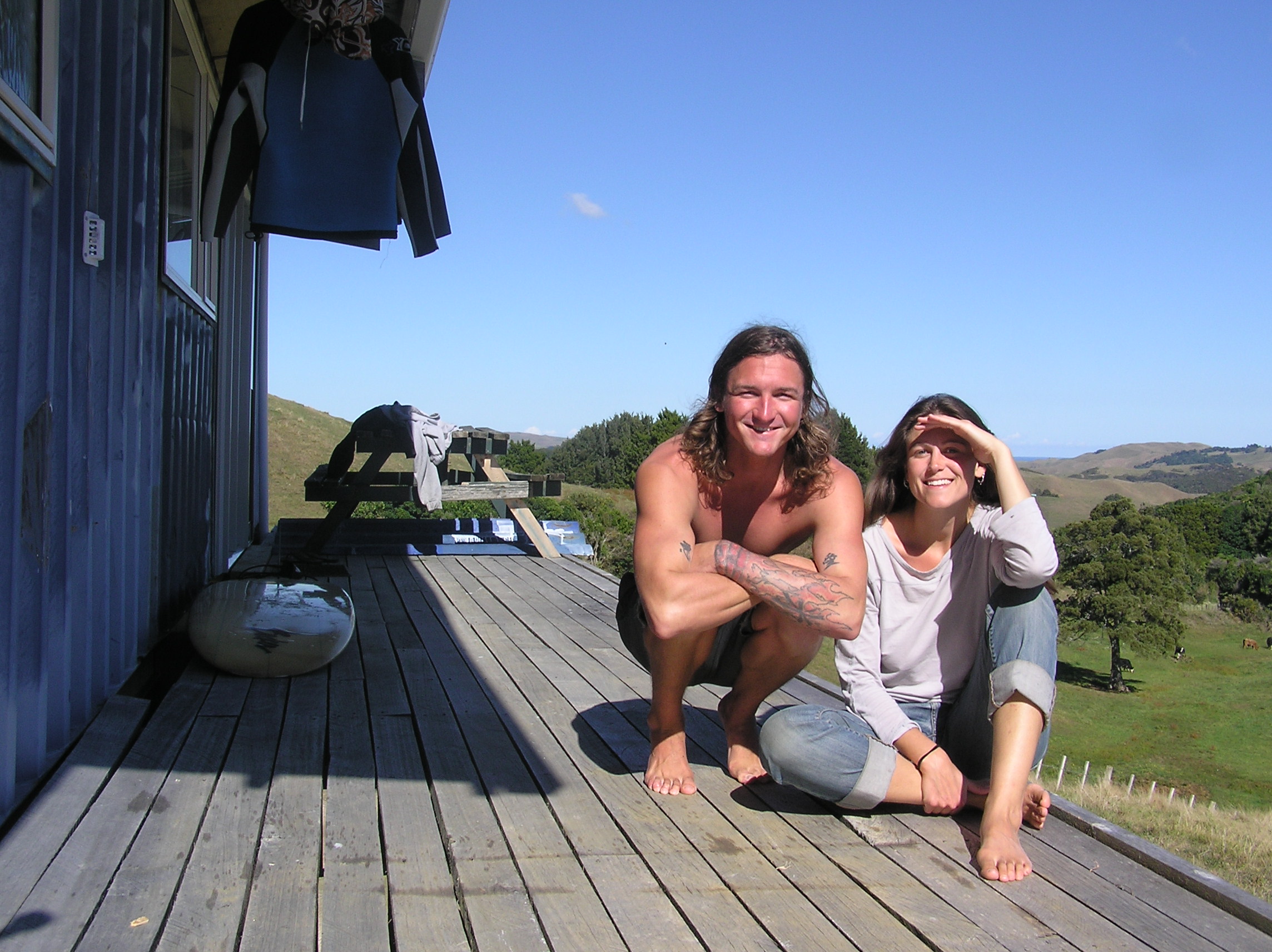
Posted by: newsurfdialogue | April 27, 2010

Up North as the trip reaches the home stretch…

After camping out at the tippy top of the North Island, Christine and I finally got in touch with a WWOOF host that had could use a couple of extra hands. For the last few days, we have been staying with Leigh, Donna and Victor at the home tucked into the hills outside of Ahipara. I knew that when we were gifted with a whole Kawahai fresh outta the water just north of Kataia, that something good would come of it, and that evening we were at our new WWOOF stay, carving up the several pound marine fish into sashimi, marinating chunks into ceviche, and smoking a portion of it with Manuka wood, brown sugar and honey.

 The surf has been flat, but looks to change anyday now. In the mean time, we have been clearing bush for a small passionfruit orchard, collecting seaweed off the beach as a fertilizer for their garden, plastering up a earth/cement wall, climbing moutains out the back yard and chatting the evenings away around the outdoor fireplace/pizza oven. Christine has made a “go fish” maniac out of young Victor (Donna and Leigh’s five year old). All we need now is for the reef points of Ahipara to start firing. Not a lot of time left here in New Zealand for us. What a concept that is…

Posted by: newsurfdialogue | April 14, 2010

Raglan pics

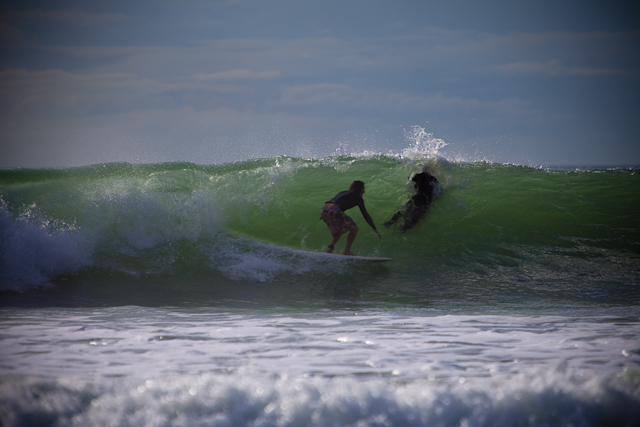
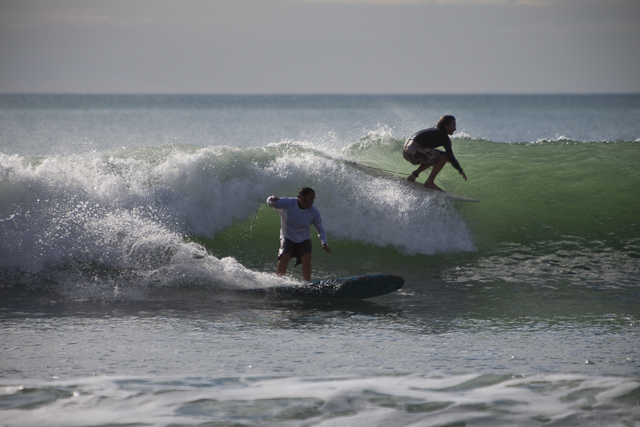
On our first day surfing Manu Bay in Raglan, Christine was along the shore taking some pics and met a photographer who is trying his hand at surf photography. He snapped a few of me and sent them to us. Thanks Dave!

The dude on the longboard kept dropping in on everyone and refused to get off their waves. Christine says one guy finally just ran his ass over. Whatev's bro, here I am locked in the pocket...

looking for the green room...

Posted by: newsurfdialogue | April 13, 2010

Raglan

morning sun children

4/13/10

Finally some rain. The road has been a dusty, tin heap rattling affair these past two weeks. Many through ways along the coast around the Raglan area are yet to be paved, but well traveled, and the summer drought has left them washboarded and thick with dust that kicks up through the undercarriage of our trusty rusty campervan. We have been staying at Neil’s place, 2km off the paved highway, and twenty minutes from Raglan, and the famed left hander that Bruce Brown brought to the world when Mike Hynson and Robert August surfed here during the filming of The Endless Summer. They had the place all to themselves when those reels were shot, but today, Raglan is an international surf tourism magnet. Holy crap a lot of people come here.

But out here at Neil’s place, where the crickets and the cows are the only sounds one has to deal with, Raglan can seem

neil's place

 pretty country. We weren’t going to spend as much time here as we have. Both of us knew what a tourist trap Raglan was, but we both wanted to at least experience the place for a day or two, and I really wanted to see the lefts peeling off the multiple points of Indicators, Whale Bay and Manu Bay in the most intimate way possible. After a few great days of surf and freedom camping just outside of town – along one of those dusty dirt traps, where the views are dramatic sea cliff portraits to the horizon- we met Neil in the Manu Bay parking lot, he and I exchanging pre-surf pleasantries before getting into the Tasman with the sunrise, and he and Christine chatting after he had caught his share at Boneyards and the wind began to screw things up. When he found out that we were living out of the van, he offered us his place to stay at. He needed to leave for Auckland for several days, and was really hoping to find someone to house sit for him before he left. So we took him up on his offer, and have been here for nearly a week now. The waves keep coming too.

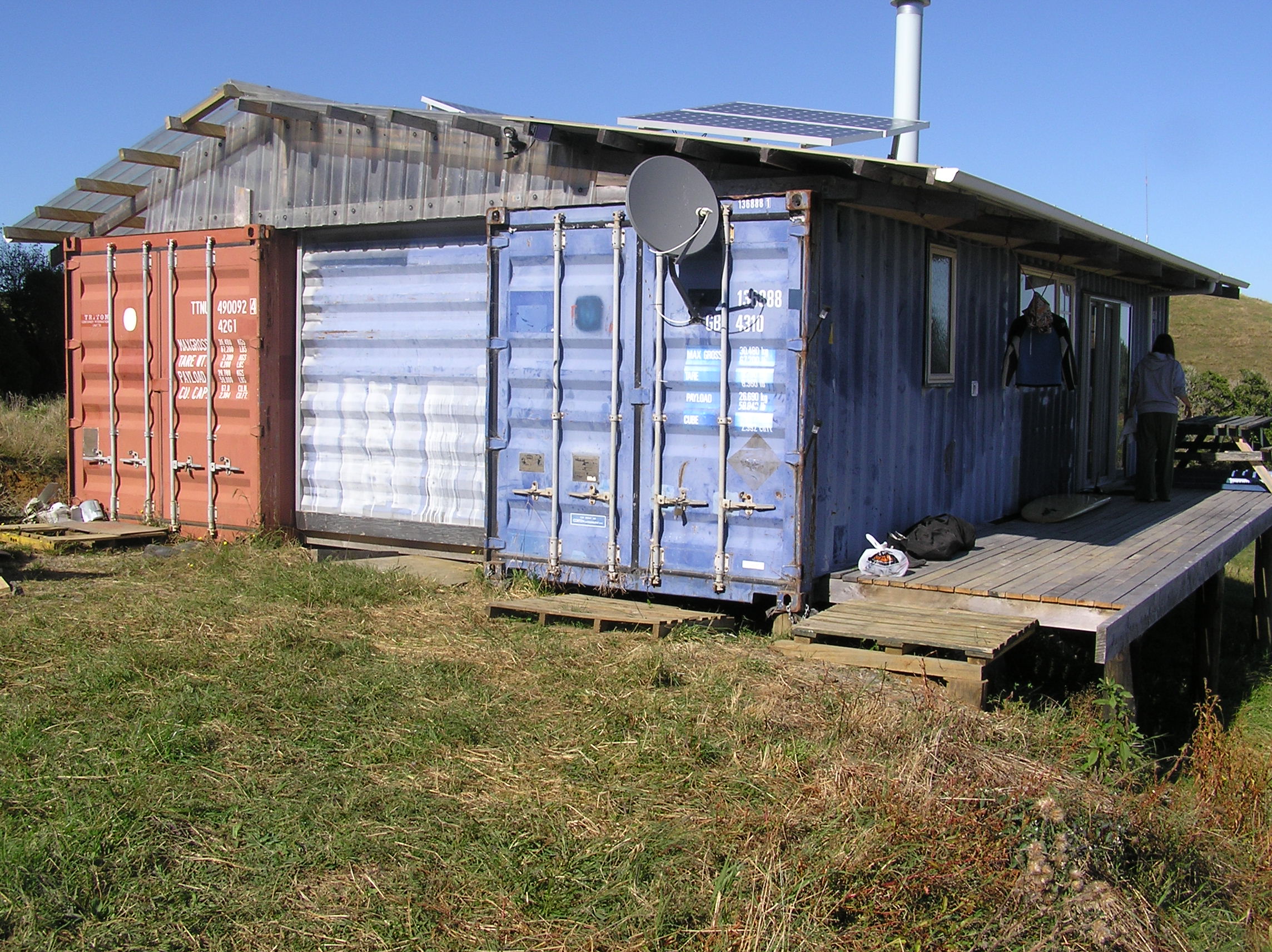
He bought the property a couple of years ago, and has been constructing an off the grid home built from old shipping containers. Think gravity fed rain water from the tap, solar panels for electricity and a composting toilet. The place isn’t 100% green – the stove top runs off diesel, but will be converted to bio-diesel, and the water is heated by LPG (liquid petroleum gas), but the efforts he has made are pretty inspiring, as is his generosity. He invites travelers and surfers to come and stay with him all the time, enjoying the company that helps fill in the gaps between the cricket chirps and cow moos.

He’s heading back here in a day or so, just in time for the next big swell, and we’ll probably spend an evening together before we head into Auckland ourselves to speak to a group of UW students who have come to study for the Spring quarter and are about to have their first WWOOF experience as a component to their study abroad. One of the professors leading the study is a personal friend of mine, and we are both looking forward to a familiar face.

The rain is such a sweet sound; draining off the rooftop, filling up the water tanks and calming the dust storms for our morning commute through the cow paddocks and wind farms to the seashore. Life’s a beach.

Posted by: newsurfdialogue | April 3, 2010

Hanging out in Waikato

April  4, 2010

Easter weekend is a four day beer fest in New Zealand. Fishing derbies and drag races for Jesus are perfectly acceptable parallels to church house sermons and coffee/donut receptions. Campgrounds fill up as all the townies flock to the beach to sun their pasty flesh and cram their mouths with meat pies and fried sea fare, chased down with Jim Beam and cola in a can.

We had spent a few days on the coast a bit south of Raglan, where good surf and an army of flies kept us company before we headed further down the dusty metal (Kiwi for gravel) roads and away from the waves before the crowds descended, having made futile calls to WWOOF stays where the phone line just rang and rang. Christine and I found a quiet patch of grass off the beaten track of the Kawhia harbor early; a place where only the locals come to launch their tin boats with the high tide to fish for snapper and flounder with the family. Cows and turkeys chew their cud and peck at crickets in the front yards of the few residents whom call this corner of the north island home

Yesterday, we headed back towards Kawhia to get some diesel and water, and to dig around in the hot water beach. At the Oparau roadhouse, proprietor Bill convinced us to park it for the night, free of charge, and opened up his house and kitchen to us, for showers, laundry and endless plates Brenda’s home cookin’. Fried chicken, venison sausage, pork chops, mushrooms and green beans, fresh from the garden salad, steamed potatoes, fried kumara, beets outta the can… Serious roadhouse fare cooked from scratch. Christine lent a hand in the kitchen, and I helped get the rain water reserve tank flowing up to the guest house.

I’ve been trying to figure out how to get to a spot on the map that looks prime for surf, but lacking in accessibility. Asking Bill about it, he just shook his head and explained, “Nah, you can’t get out there. For one thing, your skins the wrong color. Outsiders aren’t too welcome in those parts. Secondly, the locals out there like to grow their marijuana plants out there, along the cliffs and in the bush. Not real keen on anyone running up on their stuff. Don’t really care whether your man, woman or child.” He told us a story of an older couple who had traveled out and pulled off the road for the night in their campervan, out near the point I’ve been interested in. Local boys woke them up with a good shaking of their van, a few rocks thrown into the doors and a proper chasing outta town. They rolled up to the roadhouse shaken and confused.

 Weird local folklore and realities of multicultural society entrenched in archaic drug laws and racially frustrating histories. The walls to climb in the search for those perfect waves, too often avoided with indifference and readily available short cuts advertised in the back pages of Surfer.  All major credit cards are accepted. Exclusive access to world class reefs. All inclusive.

The cultures, they keep coming into the roadhouse, buying up provisions for the day. The meat pies and sausage rolls and lunch meats are packed into chilly bins alongside the salt ice and pre-purchased lager (no alcohol sold on Easter). Lotto tickets are stuffed into purses and oversized wallets, and hangovers try to hide behind knock-off designer sunglasses, only to hang out in a faint cloudy halo above slow moving red-faced heads that pretend to read the Waikato times.

Tomorrow we head back to the Raglan area, as a new swell fills in. We are going to  call some WWOOF hosts, and harvest mussels when the tide dips down. In a few days Christine turns 31. It’s a celebration bitches’.

Posted by: newsurfdialogue | March 26, 2010

Thesis part 6

***

Febuary 10th, 2010

We’ve been staying at the Waipare Homestead for two weeks now, after following John and Mihi’s lead. The house, tucked off the beach amongst Norfolk pine, Moreton Figs and copious kawa-kawa was built in the 1880’s out of Kauri wood – almost head to toe. Scrubbs (as he is called by everyone – Don being his proper first name) bought this place two decades ago, and he and his wife Louia have been hosting WWOOFers for 16 years. Within minutes I was deep into conversations on Miki Dora, Michael Peterson, and my Re-Thinking the Endless Summer theories. “You know, of all the surfers that have come through here, I’ve never had conversations like this with them! And you’ve only been here an hour! The history man, that’s where its at!”

 Scrubbs has been surfing since the early 1960’s and Louia, having grown up on the Mahia Peninsula – home to well known and well guarded waves, as well as being a Miki Dora hideout during the 1970’s- is a connoisseur of surf culture herself.

“Your doing you thesis on surf culture! Surf culture!” she exclaimed and giggled when I told them the purpose of my side of our New Zealand experience. “So you’re a bum! A good for nothing! Ha Ha! Come and help me dig a trench around Honey Lee’s tent outside. We need to keep her shit high and dry, right bro?”

The rain kept coming too. By morning, the roads where washed out all over the area, some rising 6 meters or more above their normal flow lines. A giant plum tree went down near the orchard that first night, and by the following afternoon, Christine and I, along with the two other WWOOFers – one from Florida who had been here for two months, and another from Germany who had spent time here four years ago and had just dropped by the previous day to say hello – were out in the intermittent downpours with chainsaws and branch wompers, hacking away at the felled debris.

The girls – Louia, her two daughters Honey Lee and Juliet, and Cassie, the Floridian WWOOFer all left for the AC/DC concert in Auckland a few days after Christine and I arrived. The two of us, along with Scrubbs, would spend the next several days locked into the dribbling beach break lefts and rights out the back door, and into conversations over the incredible history and perceptions that surfing has given to us. The mind altering lifestyle that becomes you, submerged in the ocean’s life lessons. Philosophy and politics and the madness of the human condition and spirit were passed around the dinner table each night. We hooted and hollered at our own surf movie screenings held in the living room. A viewing of The Endless Summer brought many of my idea’s back into perspective, and we cringed and cracked up at Bruce Brown’s horribly off-color imperialistic colonial comments about the “primitive” African’s that Mike Hynson and Robert August encountered during their search for the perfect wave. Thomas Campbell’s film ‘Sprout’ blew Scrubbs away with the embracing of boards long and short with abstract concaves, convexes and varied numbers of fins, and his generally brilliant artistic representation of the diversity of modern surf culture. However, in all the film’s beauty, filmed in exotic locations around the world, little attention is paid to the lives and livelihoods of the locals who call the exotic locales home.

  We also worked around the yard, helping get the grounds ready for the next wedding being held here in a few weeks, and harvesting heaps of organic basil, lettuces and nastirsum flowers and leaves for nourishment.

After a fun morning session the night after viewing Sprout, Scrubbs stoke meter about to burst, Christine and I had laced up our boots and were heading out to attack the Plum tree and pick some avocados after the three of us had just finished a potato and egg brunch. “I reckon the waves are still looking pretty good; probably time for another session,” Scrubbs announced, having just been down to the water to survey the scene. I started to say, “oh yeah? Christine and I were about to get on that tree again…” and was quickly cut off by a moment of hysteria from Scrubbs, “Fuck work man, the waves are better than this morning! Lets have another session! That other shit isn’t going anywhere! Priorities man!” So, when in Rome…

Scrubbs continued to stoke us out with all his local knowledge of the area’s surf breaks. We took a ride up the hill for a surf check one morning, and based off the visual clues we could acquire from a vista where miles and miles of coast could be observed, he directed us to the right spot at the right time, and I finally scored some decent surf in New Zealand.

A few of our days this past week were also spent on a friend of Scrubbs vineyard, helping them prepare the vines for the nets to keep off the birds. The berries are filling with sugar, and we enjoyed the change of pace and hands on experience with the local wine culture. However, we are increasingly in tune with the fact that New Zealand is in no way the ‘100% Pure’ landscape that the tourism board sells to the world. “That’s a fucking scam isn’t it,” Scrubbs quickly replied when asked about the slogan, and then raising concerns and giving examples of how polluted New Zealand has become. Choppers saturate the local squash and corn fields with chemicals on a regular basis; one of them swooping across the neighbour’s fields while we plucked new growth off the vines, causing both Christine and I to worry and wonder. “We were rained on with those little white pellets just the other day from a copter,” Louia mentioned during one of our conversations, referring to 1080.  “Fucking bastards.” One afternoon in Gisborne, we caught part of a documentary on the chemical 1080, which was playing on a sidewalked television outside a hippy store. It is used in New Zealand to kill the invasive possums, stoats, rats and other rodents, and a scary topic for biologists and environmentalists from around the world. The forestry practices have long been destroying the landscape too, as well as the cattle and sheep industry polluting and trampling the erosion prone hillsides and water ways, with signs up in all the campgrounds and holiday parks warning people to boil their water before drinking because of high bacteria contents.

Yesterday, we continued to plug away at the Plum tree, Christine going for an afternoon swim with Honey Lee and Juliet, me reading the through the stack of books on surf history and local folklore that Scrubbs had dug up for us. The sun has dried up the downpours and the road is waiting. Scrubbs and I hongi’ed and contact info was passed along to us; surf bros done south that would love to show us around. Off toward the South Island. Off to track down Miki’s ghost, and to volunteer our hands and stories on other New Zealand homesteads and farms.

***

After The Endless Summer, and as the 60’s progressed, surf culture continued to evolve in regards to the ways surfers rode waves – i.e. boards became shorter and styles more aggressive, hair grew longer, and the music louder – but it only further embraced the Romantic idealization of escapism, of surfers as world travelers seeking out the images of perfection that they were being fed by their own medias, and as the crowd situations hit critical mass in the surfing hot beds of California and Hawaii (again a by-product of their own medias and travels, with heaps of help from Hollywood). Surfers incessantly touted themselves as individuals, “escaping from the confines of a western society gone awry in search of a pristine, tropical paradise, unsullied by crowds and commercial industry,[1]” by living in harmony with nature, connecting to the direct energies and forces of the natural environment by riding mother ocean’s waves while travelling away from the polluted environment and idea of the city. Throughout the 1971 surf film “The Sunshine Sea”, the narrator reinforces these ideas by stating, “Riding a wave has become a basic expression of man in harmony with his environment,” and that “The ultimate message of surfing is the wedding of nature and man, a return to something simple, basic and individual. The surfer accepts the natural order of the world, a natural balance of man working with the environment instead of against it.” The ocean was a force to be respected, and one that was not easily tamed. Ford and Brown note how Auden, “summarizes the distinctive Romantic attitude to the sea as including the desire on the part of the man [sic] of honour and sensibility to leave the land and the city, to voyage on the sea as the true test of masculinity, the realm where the decisive events, the moments of eternal choice occur.” These sentiments have been strongly at play within our contemporary surf culture as it has fed off the images and messages of the 60’s and 70’s, even more so when big wave riding is figured into the equation.  In Alby Falzon’s Morning of the Earth (1971), surfers are shown ‘living off the land’ in the Australian countryside, shaping their own boards and surfing their brains out in uncrowded waters. The film takes the viewer to Bali, where the waves had just been “discovered” and the people still living off the land in a tropical paradise. These films were successfully selling a lifestyle and mentality with the best intentions, but other Westernized concepts would flood the surf world, and the reality of harmonious co-existence would fade.

                Enter the 21st century. As world travelers (generally speaking), surfers and non-surfers alike, aren’t living any sort of harmonious existence with our environment, no matter how you spin it and surf tourism is manifesting greater socio-political concerns. Dr. Tony Butt, who has a regular column in The Surfers Path, a UK based enviro-surf magazine, recently reported his own findings on the surfers carbon consumption compared to the average non-surfing citizen. His stats were geographically specific (compiled from his own poll via The Surfers Path), but in all areas of the world, surfers are much greater carbon consumers, leaving unsustainable footprints as they escape the pollution and crowds of their home breaks by flying off to exotic locales, or simply from driving up and down their local coastlines looking for surf and relief from the crowds. We ride boards and use wetsuits made from toxic chemicals. We travel to places like Indonesia, and take advantage of foreign owned surf charter companies, hardly stepping foot on land or contributing to the local economic base[2]. In these third world surfing hot spots that do develop land based tourism, the thrust of Westernized economies into the areas often leave the locals staggering to catch up with the foreign investment that has taken advantage of comparatively cheap land, labor forces and lack of environmental regulations that are readily available, so that the travelling surfer can live the dream[3].

In a Surfer article on surf colonization, based off his experiences and observations in Bali – a destination highly glamorized and publicized by the surf industry since Morning of the Earth, Steve Barilloti explains that, “in the wake of the explorers inevitably follow the settlers…while the baseline activity of surfing is essentially non-exploitative, once surfers set up a collective around a marquee surf break suck as Jefferys Bay or Uluwatu, the impacts of human colonization – trash, roads, erosion, water pollution, development, environmental degradation, resource depletion – inevitably follows.”  In his surf travels, Barilotti has observed that, “most surfers travel not to experience another culture but to find waves similar to their home breaks but without the crowds. In many cases the indigenous people are an obstacle or a friendly nuisance to sidestep on the way to the water.” That is not living harmoniously, and  is also a sentiment that I second from both my own travels through Mexico and Costa Rica, and from all the surf media that I’ve consumed over the years. The waves are the thing for far too many surfers. The crowds, and the ‘surfers gaze’ created by the medias – a gaze prescribed by the images we consume and the desires they produce – are the inspiration for that endless summer ideal. Barilotti makes another important observation, that “surfers seem ill-equipped to handle the big questions of geopolitics and globalization. The surfing gestalt is based on cool indifference to concerns of politics, religion or class,” which would explain the justification of how surfers travel, never realizing or acknowledging that they themselves create the crowds, deepen the economic divide in undeveloped (at least in westernized concepts of the term) communities, and greatly contribute to global warming in their wanderlust,  and will continue to do so the more they explore and push the frontier boundaries. It would explain the profiting existence of dozens of foreign owned surf charter boats operating off the Mentawais in Indonesia, where surfers live and surf in luxury accommodations within spitting distance of communities ravaged by malaria and corrupt and racist governments[4]. Or that they are partly responsible for the social and environmental problems that arise when a place like Bali is turned into a cess-poll surf ghetto by non-local enterprises.

                I think it is time to move away from the Romantic model of yesterday if we really care about surf culture and the one planet that we have (not the theoretical seven that it would take to sustain surfers at their current levels of consumption[5]).  I find it the ultimate irony, that surfing, an experience and culture once driven toward darkness by western colonial advancement and antiquated religious doctrine, is now the responsible for another wave of oppressive western colonialism and the new globalized religion of capitalism.

 Luckily, not all is doom and gloom and there are people and organizations and alternatives that we as surfers, can look to, support and engage in if we do decide to make global travel a part of our life. Surf Aid International, a New Zealand based NGO was “formed in response to travelling surfers observations of inadequate (often absent) health care facilities in many destinations frequented by surfers.[6]” Surfing doctor Dave Jenkins started the non-profit around the millenium after growing fed-up with the lack of basic health care available in the Mentawais, and focuses on delivering basic health needs, training local health workers and applying for grants that go toward indigenous causes. “We believe that everyone who partakes in the surfing culture, be it from reading, writing or advertising in a magazine, watching or producing a video or wearing a label, has a role to play in helping these people…we know that most surfers care – but in the past have lacked a relevant vehicle for helping.[7]

                   While in Peru on a stint with Peace Corps., Dave Aabo, co-founder of WAVES for Development, was making weekend trips to the coast to sneak in surfs and release some stress. Some of the places he surfed, like Chicama and Máncora were developed surf towns. However, Aabo knew that they were towns were the locals weren’t necessarily reaping the benefits or in control of the situation. “If you look at a town like Máncora,” he explains in The Surfers Path, “it has become the Northern Peru surfing destination. There are surf camps, restaurants, nightclubs…However, it’s one of these places where the people benefiting are not the locals…they are often from Lima or they are foreigners.[8]” He was also deeply bothered by lack of cultural exchange and reciprocity that he witnessed. “There were people coming in, bringing in lots of money, bringing in their  $500 surfboards, $20,000 cars, strolling up to the beach, hooting and hollering on the waves and then leaving,[9]” so when he visited an undeveloped wave haven 30 miles to the south, he was inspired to make effort that would keep the inevitable forthcoming tourism development in the hands of the locals. “We knew it was a special place, and with a wave that good, it was only a matter of time before big things started happening here.”

                WAVES for Development (Water, Adventure, Voluntourism, Education and Sustainability) is getting the local kids in the water with hundreds of boards donated to the program, as well as teaching them board repair skills, entrepreneurship and English. The program has both a permanent staff and a cast of travelling volunteers and a mantra of “Making the world a better place through surfing.” For Aabo, WAVES is his contribution to re-thinking the wave centric travel mode, or as he puts it, “to use surfing to accomplish more than the selfish need of getting the best wave.[10]

                Dr. Jess Ponting, who’s PhD is in the field of sustainable surf tourism believes that as surfers continue, “going on trips to exotic locations expecting to find the surfing paradise that they have seen in magazines only to find areas that are deeply troubled, sometimes with humanitarian crises on the land right near the breaks,[11]” that these experiences will continue to dislocate the Romantic idealized notion of surf travel. Surf culture will continue to evolve, as it has to in order to survive, and this new enlightenment should produce a desire to share, to help out and to learn from the communities that we encounter while on the search.

We need to embrace alternatives.  Make the trips count, and make them last, use the carbon footprint wisely. Spend some time getting to know the communities you travel to, doing some research before hand, seeking out local organizations that could use some help and figure out where you money  is going to. Whether it is traveling to Indonesia and helping deliver Malaria vaccines, or Peru to tutor a kid in English while they tutor you in Spanish before sharing a session in their backyard, there are heaps and heaps of ways to become involved while surfing too. On your next journey down to Mexico or Chile, see if there is a WWOOF farm near your destination. Get local, get creative, and get stoked.

In Duane’s, Caught Inside, he chronicles a year in his life getting to know his own surfing backyard in intimate detail; the history, the flora and fauna and swell details for all the off the beaten path breaks within an hour of his home. I’ve read about surfing icons retro-fitting their bicycles and kayaks to accommodate surfboards and camping gear, travelling locally for new perspectives and less environmental impact. There are so many options, so many roads less traveled, often right there at home. We just need to slow down and take a look out the window. What is out there? What are the possibilities right here at home? I know that when Christine and I return stateside, that all these stories and experiences are going to encourage us to stop and smell the roses and lilacs and home sweet home sea breeze scents even more then we already do.

***

March 20, 2010 Milton, New Zealand 9:08am

                I spent yesterday morning milking the goats with Jack, feeding the chooks and a bit of weeding with Christine out front to make room for more strawberries. The three of us cleaned a honey comb out of its bee box wood frame, and put it in a cleaned up empty ice cream container for Christine and I to enjoy as we continue our adventure through the islands. After our afternoon tea, Jack told us stories from childhood, the ones that have shaped the man that he is today. How his Maori culture called him back from his Jehovah’s Witness up-bringing, how the histories of Aotearoa and New Zealand are looked at now with enlightened visions inspiring new concepts for the countries future. He told us about the mischief  and epiphanies, the good and the bad. Then we laid mud mats down around the garden, and enjoyed an evening tea of ceviched mussels and butter soaked blue cod and thanked each other for the hospitality, knowledge sharing, and old fashioned good times.  

                Christine and I need to pack up the van once again, and continue heading south. The swell is there and the winds offshore, hanging around the Catlans and Southland, but a new weather system is moving in quickly. Cyclones and tropical storms are raging around the seascapes of the Tasman and the Pacific. It’s all one big wave really, this trip, this life, at least that’s how I see it, and we’ve only begun to drop in. Kia Ora.


[1] Quoted from Endo.

[2] See Ponting.

[3] See Ponting, Reeves, Barilotti.

[4] See Ponting, Barilotti.

[5] See Butt.

[6] Quoted from Ponting.

[7] Jenkins quoted in Barilotti.

[8] Quoted in Endo

[9] Ibid.

[10] Ibid.

[11] Ibid.

Works Cited:

  • Barilotti, Steve. Lost Horizons: Surfer Colonialism in the 21st Century. 2002.
  • Brown, Bruce, Director. The Endless Summer. Columbia Pictures. 1966.
  • Brown, David and Ford, Nick. Surfing and Social Theory: Experience, embodiment and narrative of the dream glide. Routledge. 2006.
  • Butt, Tony, PhD. Are Surfers Environmentally Friendly? The Surfers Path. #71 April-May, 2009.
  • Crawford, Carin. Waves of Transformation. Self published master’s thesis. www.lajollasurf.org/wavesof.html
  • Duane, Daniel. Caught Inside: A Surfer’s Year On The California Coast. North Point Press. 1996
  • Endo, Tetsuhiko. The Stoke Virus. The Surfers Path. #75, Dec/Jan 2009/10.
  • Freeman, Jim and MacGillivray, Greg, Directors. The Sunshine Sea. 1971.
  • Jamieson, Philippa. The Wild Green Yonder: Ten seasons volunteering on New Zealand’s Organic Farms. New Holland Publishers. 2007
  • Kampion, Drew. Stoked: A History of Surf Culture. Gibbs Smith. 2003.
  • Leuras, Leonard. Surfing: The Ultimate Pleasure. Emphasis International, 1984.
  • Moser, Patrick (editor). Pacific Passages: An Anthology of Surf Writing. University of Hawai’i Press. 2008
  • Ormond, Joan. Endless Summer 1964: Consuming Waves and Surfing the Frontier. Film and History: An Interdisciplinary Journal of Film and Television Studies. 35.1. 2005. P.35-51.
  • Urry, John. The Tourist Gaze. Sage Publications. 2nd ed. 2002.
  • Warshaw, Matt. Surf Movie Tonight!.
Posted by: newsurfdialogue | March 26, 2010

Thesis part 5

***

January 28th, 2010

Christine and I are taking our time and not letting the lack of swell bum us out to much. We are in Waipiro Bay right now, having parked our home under a N.Z. evergreen across the quiet dirt track that outlines the cobblestoned south side of the bay. I think this place needs a good extra foot or two of swell from the northeast to really start to take off and show some form and function for a solid dance routine between the surf starved and the lonely long legged wavestress that I observe rolling along the point, but not breaking, in a tortuous mother natured strip tease. “Wow, this place has some serious…,” and Christine chimes in and finishes my thought, having heard a few days of the same comment, “potential, right?”

 I took the fish[1] out last night after the tide had dropped and caught a few knee high dribblers breaking just inches above the boulders. Another couple joined us here at the bay, an English couple from Cornwall, Hugo and Rose. We had seen them the day before, as both of us were driving the same southerly path, pulling over at a couple of the same bends and viewpoints on the East Cape to look for swell. This spot was too much of a coincidence, and demanded a formal greeting, as we are well off the main highway, and toward the end of a narrow, bumpy and secluded empty road well north of the Gisborne area. We communed our food and cooked up a nice big pot of Mae Ployed pasta and silver beets with extra butter and sardines out of the tin. We passed the peace pipe and talked about our journeys so far, with Hugo and Rose having spent a month here already.

Before eating, Hugo and I were standing along the heaps of driftwood and cobblestones, overlooking Wapiro. The rugged hillside is awash with evergreens, rough lipped shrubs, seaside grasses and rocky faced cliff drops facing the sea and wrapping this entire natural splendour around the bay, coming straight from the depths of the western Pacific and rising several hundred metres or more.  Wide winged hawks drift up and down with the shifting pockets of wind kissed air. Mozzies buzz and dive for any of our flesh they can find. The sun had set behind the hills, and small, too small to ride, sets of waves were breaking in uniformed regularity along the sweeping point. So much potential…

“Sometimes I feel so lucky to have this as the thing that I do…surfing…surf travel…having this as such an intrinsic part of my life, it all seems so unreal, so ridiculous,” Hugo mentioned as our bodies and eyes faced the northern landscape. The dusk was turning our view into a Wolfgang Bloch painting. The bay and landmass turning  multiple shades of dark grey, with small brush strokes and scratches of brown and red visible amongst the darkening hillsides streaking across the most natural canvass, adding dramatic nuance, depth and complexity.

“Yeah man, to have this as what you do, surfing, travelling off to places like N.Z. in search of waves and all that is attached to that search; like this,” as I motion with my hands from right to left, to drive home the overwhelming grandeur of our immediate environment. “We are pretty fuckin’ lucky. And sometimes I think about other people’s passions; the things in their lives that keep them going, give them that fired up excitement, like NASCAR or college football, and I just don’t get it. I think they are fucked up and crazy. But I know that is a closed minded thought to have…self-righteous…judgmental…There are other ways to feel what we feel…We are lucky though, so lucky to see and feel the world through our surfers gaze.”

January 30th, 2010:

Spent the day in Gisborne City. Making contact with potential farm hosts to show us around their fruit tree, shorn sheep and bee hive lifestyles.

The library is a noisy adventure with no restroom. Have to head next store to the police station. Put 20 cents on the counter and pee away.

At Woolworths we buy real, authentic New Zealand minced lamb for pan fried burgers. Silver beets for vitamins and ruffage. Mineral waters for drink. Cheese is already in the chilly bin. Whittaker’s chocolate for pre-dreamstate indulgence.

Head down a dirt road, north of town and on the beach. There is a nice grassy knoll off to the right, just need to scoot our house across a patch of sand. Steadyyyy. Steadyyyyy. Tires begin to bury themselves. Chassis sits up real nice and comfortable on a patch of grassy hard pack. We are fuckin’ super stuck.

Dig and dig and dig. Shove timber under the tires. Punch the van and scream obscenities. Repeat. Back door lock seems to break. Continue the madness for one hour. Bloody knuckles and hungry bodies.

The sun begins a final descent beyond the hills. We are debating a hitchhike into town or a night buried in the sand.

“Someones coming…,” Christine says, “…pickup truck…yep, GDC on the side.” Gisborne Dept. of Conservation. Paid land stewards and enforcers of law and order amongst the sand dunes and tide pools.

Curly haired beer belly man gets out of his government vehicle. Che Guevara’s face printed on his red t-shirt, ‘Cycling Revolution’ printed below.

“Looks like you could use a hand. Thought I’d come down, take the dog for a walk and pull you out. Been watching you from town for awhile; from the camera up there,” he mentions as he points out the survelliance machine up on the hill, pointed right at us. Big Brother here to save the day. “You got a tow hook under there?”

Christine blushes, thinking to herself of how she had changed her top awhile ago, hoping he hadn’t been zooming in for a closer look. “You guys ever see the movie Whale Rider,” he asks, while reading my anti-capitalist punk rock t-shirt, “filmed right around the corner here. Pretty good film I reckon.”

We kept busting knots and rope braids, the bastard van acting like a rock wedged between two boulders. Our Marxist angel drives off to get reinforcements, as darkness blankets the day. The stars come out and unseen waves break gently on the offshore reef. Somewhere near here, Moko the dolphin patrols the Gisborne coast line.

With crayfish rope procured from a buddy’s house, the van is ripped from the granulated stone, one pedal to the metal surge that sends the van in a mad fishtail. Up and over the ditch, wanting to tip over as I struggle to control the unexpected herky jerky climax from the drivers seat.

“Yeah! Just a little bit of fun for the night in Gizzie for ya.”

“Yeah, piece of cake man. Nice and smooth. What was your name by the way?” I’m a bit stunned really, so is Christine.

“Jamie.”

“Cheers Jamie. Thank you so much dude.”

“Yeah, well now’s when I pull out my Colt .45 and rob ya! But seriously, no worries mates. I had a good buddy driving round the States once. He broke down and some good folks took him in, fixed his car for free and gave him the keys to their cabin for the night. I reckon that’s what people should do for each other.”

Off he drove, leaving us to calm down and figure out the rest of our evening.

“Holy shit. I can’t believe you didn’t tip over. The van was like a feather in the wind. Jesus Christ.”

“I wasn’t expecting that. At all.”

We pulled around the gravel cul-de-sac, a few meters from where we had been stuck. Cheese, bread, tomato and mustard feast. Lamb burgers will have to wait. The chocolate doesn’t. Swatting at a handful of mozzies diving for our earlobes, we pass out in exhaustion.

Daniel Duane was right, the surf trip story lies not within the details of ridden waves, but of the rides to those waves. He says in his novel Caught Inside, “The broken truck axle and the six hour hike through the Baja desert for help are far more likely to be repeated years later than how “I made this superlate drop, and then the wave hit that inside bowl and just throated me.” The story is imbedded in the people, places, and things one encounters while on the search, or even while pocketed into an empty perfect wave session in the confines of paradise.

January 31, 2010:

A north east swell was supposed to come in today. I woke up a few times during the night to the sound of waves crumbling along the bouldered point and manic moments of heavy rain and wind. My dreams were deep animated wave songs that curved and melted off the backs of my eyelids in bleeding reds and blues; no doubt feeding off of the aural songscape drifting in through the windows of our van.

 A cup of green tea and walk around the bend with the sunrise reveals no wave party. Swell lines rise and fall as the ocean tidal surges ebb and flow over shallow and deep contours near the shore. This swell just isn’t quite big enough, not at the right angle or just not in the mood to curl her turquoise top into a walled up face capable of inviting a wave rider onto the undulations of her cheeks and chin. The rain takes a break, but only for a moment, and Christine and I have a cup together and I move the van under the cover of a open aired, but roofed, dirt floored parking area attached to the vacated fishing clubhouse. With camping chairs and books in hand, we read and wait out the rain, hoping that the rising tide will us bring us a gift.

In Leonard Lueras’s, Surfing: The Ultimate Pleasure, he points out that flat spells have long driven surfriders to frustrated lengths. He references a 19th century Maui circuit court judge, Abraham Fornander, who authored, An Account of the Polynesian Race: Its Origins and Migrations, which details a specific ancient Polynesian “surf coaxing ritual,” where distraught surfers, with the help and guidance of  a kahuna, would whip the water’s surface with strands of pōhuehue, or beach morning glory, until the waves returned. A chant would accompany this action. Translated, the pōhuehue chant reads:

Arise, arise you great surfs from Kahiki,

The powerful curling waves. Arise with the pōhuehue.

Well up, long raging surf.

Fornander, as Lueras describes, also documented chants of demigods intervening with oceanic quietude for the sake of discontented surfers. 

A chant about Laenihi, a Hawaiian woman with celebrated mystical powers,

recalls how she forced winds to blow and caused “the sea to be aroused from

its calm repose.” This wave generating wind, called the Unulau (or trade wind),

did its mystical thing, and as the chant notes: “Early that morning the surf

began to roll in. When the people rose from their sleep and saw the surf, they

all began to shout and yell.”

And with the stoke flowing through their bodies, they no doubt paddled out and had an epic session. Unfortunately, I know of no kahuna, and have no demigoddess to plead to. I have the stories though, and the meditations that they invoke, to help ease the ever so slight growth of anxiety over our inability to find a pocket of perfect, empty waves. So we sit and read, eat apples with peanut butter, drink tea and grow a bit nervous with the rain squalls. Eventually, we decide to drive out of the Bay, before the road washes out.

            There is a visitor’s center in Ruatoria, a one horse town off the main highway, just north of Wapiro. There is internet access there and telephone, so we hope to make use of it to check the weather and make contact with WWOOF hosts.

The visitor’s center was all closed up though. We go across the street to Mijo’s Dairy to ask around about it opening today, and the woman behind the counter thinks for a moment and says a bit apologetically, “nah, probably gone home for the weekend. What were you needing, the internet?” We told her we did, wanting to check the weather, see if this rain was coming to an end, to check the swell, get in touch with some people.

“Well, I guess if you just need it for a few minutes you can use our computer. Don’t think it would hurt anyone,” says the man now standing next to her.

Twenty minutes later Christine and I are in the back room of John and Mihi’s dairy, eating fresh smoked kahawai,  drinking hot chocolate and talking about the world, the Pacific Northwest, Maori-dom (John is Maori from Ruatoria and Mihi is a born and bred local Ngati Porou woman), shearing sheep, the university and the love of not having to travel. John used to surf, has an old 9’3’’ back at the house, but his knees have given up on him.

The rain continued to rain. Wasn’t supposed to stop for days. Mihi gifted Christine one of her hand knitted unspun wool sweaters. John told us to come back to carve some whale bone. They insisted that we call up their friends, Louia and Scrubbs in Anaura Bay, about an hour south of Ruatoria. They are long time WWOOF hosts, and real good people they told us. John said that Scrubbs was an old kiwi surfer with a cache boards and of knowledge and stories about this place, and Louia a Maori woman who organized fashion shows with the local kids, amongst other artsy endeavors.

John needed to get on with washing the outside walls – best done when the rains came because it saves water – so we leave for Anaura, cruise along Hwy 35, where the rivers and streams swell up and wash out the tar sealed road around this bend and below that dip. Our windshield wipers squeak across the glass in mad dashes, and the defrost struggles to keep our line of sight clear with all the humidity from the outside surrounding and emanating from us.

                                                                                                    ***                                                                                                   

                World Wide Opportunities on Organic Farms (WWOOF) came to New Zealand in 1973. A UK woman named Sue Coppard had initiated the program in 1971, based off her own desires to get out of the city and learn about farming and home gardening. Kiwi Philippa Jamieson wrote The Wild Green Yonder, a book about her 10 month experience wwoofing around her native New Zealand explaining, “The idea of WWOOF is about learning…an excellent opportunity for wwoofers to gain practical experience in organic farming and gardening, and at the same time the hosts benefit from having an extra pair of hands, and enjoy the cultural exchange with their wwoofers.” Signing up for the program is as simple as picking out a country with a WWOOF program (at last check, I counted 36 programs/countries around the world, many of which are in wave blessed areas. In New Zealand, there are over 1,000 hosts within the program!!), pay a membership fee and you’re in. There are WWOOF programs in other wave blessed countries like Portugal, Mexico, Ireland, India, Costa Rica or Chile. Besides New Zealand, surfers can re-visit Ghana and Australia as Brown and company did in The Endless Summer. When you are travelling through your host country, you simply ring up or email a farm host (hosts are found on the WWOOF website, or through the WWOOF book that you can purchase with your membership) a week or two in advance (although, as in our experience, hosts often can use your help immediately) and see if they can use your help. In exchange for room and board, generally you volunteer 4-6 hours/day around the property/farm with whatever needs tending too.  In our experience here in New Zealand, each WWOOF stay has been a unique experience. Our first hosts simply needed help with their homestead upkeep, leaving ample time to surf and hang out talking and sharing in the daily lives of our hosts and their kids. The next host was a bit more labor intensive, as they had a decent sized home garden, as well as chooks[2] and a handful of cattle to look after. We were left on our own, as the couple we stayed with were off in town and busy leading lives off the farm, and we were encouraged to work a few hours and play a few. Go check the surf, tramp[3]  around the bush[4] and parks in the area, or just to relax. In the late afternoon, Christine and I would dig up potatoes and carrots, snip some kale or other greenage, and cook up a family feast. Now, we are staying on a beautiful property south of Dunedin, and are fully immersed into the workings of a functioning family farm. We have been working alongside Jack and Debra, helping them with their goats and bees and wood piles and fences. The coal and wood (that I stock up first thing in the morning) fired stove heats the house and shower water, and is used for cooking our evening tea where we gather around the table and discuss life until our day grows dark and our beds call for our company.

I thought that this program sounded like a great alternative to the current dominant idea behind surf travel that hadn’t strayed from the Endless Summer paradigm of the early 60’s. One that would give back to the communities that I travelled to, while consuming their waves and enjoying their landscapes. It would also serve as a learning tool for both Christine and I in our future home gardening, self sustaining, low impact lifestyle that we’ve been working on together. Plus, when traveling for surf, there is never a guarantee that the waves will be there waiting for you, so in the downtime why not learn and share and build cross-cultural bonds? Sure beats going stir-crazy, or travelling up and down the coastlines burning fuel and getting pissed at the lack of perfection that the surf mags and movies had promised.

***


[1] A ‘fish’ surfboard is characterized as having a deep ‘V’ carved out of the back end of it. A design that helps shorter surfboards catch smaller waves.

[2] Kiwi for chickens!

[3] Kiwi for hike!

[4] Kiwi for woods!
Posted by: newsurfdialogue | March 25, 2010

Thesis part 4

***

January 25th,2010. Waihi Beach.

Full speed ahead as we pull out of Auckland with the sunrise and patchy, sporadic rain clouds. The city quickly turns to farm land, the Southern Highway a blur buzz of cows and sheep, maize and turned up top soil. Up and around the hills and curves and rivers of the south Coromandel peninsula to Whangamata on the east coast, I figure out the gearing of our Mitsubishi camper, and hope the black smoke doesn’t pour out of the exhaust anymore while we trudge up the inclines that stress out the old diesel engine sitting under the co-pilots chair. At Whangamata, the famed harbour sandbar isn’t producing any peaks, but Crista and I stroll the beach, stretch our legs and poke at the jellies washed up along the white sand sea line. We continue to cruise, on the left hand side of the road, and trade big ohhs and ahhhs and toothy grins as we round the corners and feast on another eyeful of New Zealand landscape. Only hours into our four month road trip and we are impressed with the sights and smells and the people who aren’t afraid to smile and wave as we pass them by.

Further south, we park it at Waihi Beach. We camp out at the beach car park for free for two nights. The surf is small, but fun, and the locals friendly and helpful. The ocean is full of jellyfish, both big meaty ones that drift into shore with the tidal ebbs and flows, and millions of little jelly tubes and spirals that make the water a soupy, gelatinous concoction that I stir up with every paddle.

The roadside fruit stands are keeping our vitamin C intake up at peak levels. Although finding fresh fish to cook up on the beach is nearly impossible. When we asked at the bakery where a fresh fillet (pronounced ‘fill it’) could be found, the guy behind the counter answered, “I reckon down on the beach with a fishing pole.” So we had pasta for dinner, and dreamt of the squid tubes and kumara root we had the night before in Auckland.

After two days in Waihi, we took a hike toward Homunga Bay in search of better waves and new horizon view points. The trail stomp vistas were awesome, with dramatic cliff drops to the sea hundreds of feet below us, but the surf was hiding out. We hiked back out, packed up and put the Zorro Blanco back into gear.

***

“White people have taken many things from many cultures, and surfing is one of them.” Thomas Campbell

Surfers travel. They have for centuries. Ancient Polynesian surfers explored and found perfect empty waves when they cruised up to the Hawaiian Islands and throughout the first half of the 20th century, and pilgrimages to the Hawaiian Islands would become a rite of passage for the small groups of surfing enthusiasts from California by the mid 20th century[1]. So what The Endless Summer did was simply continue a cultural paradigm that had long been established, but one that was fed by new Westernized models of looking at the ‘unknown’ and the natural environment. Static cultures die out, ones that adapt to the ever changing world thrive in motions of resiliency, for better or worse. When Jack London had his accounts of surfing published in the U.S. and Britian, and Henry Huntington employed Hawaiian/Irish surfer George Freeth[2] to give surfing demonstrations as a means to promote his new rail service north of Los Angeles in 1908 (which quickly sold out as thousands came to witness Freeth)[3], a new seed was planted that would marry the Hawaiian and southern California beach cultures, inspiring travel between the two destinations by the new surf communities. Duke Kahanamoku[4], a native Hawaiian and Waikiki beach boy, would follow in Freeth’s footsteps, and bring surfing to the east coast of the U.S., again to California and to Australia by 1920[5]. These events would go on to inspire the endless summer vision and a global contemporary surf culture, one that finds surfers from country A running into surfers from country B while tramping around lonely, dirt tracked roads in country C in ever increasing numbers. Besides the pilgrimages to Hawaii throughout the first half of the 20th century, California surfers began cruising down to Baja, exploring the points and reefs years before The Endless Summer. However, as Kampion reiterates, “it was the epiphany of Cape St. Francis – that perfect, peeling wave waiting at the end of a long trek over the dunes in The Endless Summer – that ignited the explosion in surf travel that would shape the sport for the rest of the millennium.”

***


[1] See Kampion

[2] At the turn of the 20th century, Freeth was regarded as the best surfer/waterman in the world.

[3] See Kampion, Ormond.

[4] Regarded as the “father of modern surfing”, Kahanamoku was an Olympic gold medalist and world record holding swimmer, incredible waterman and Hawaiian ambassador to the world.

[5] See Kampion

Posted by: newsurfdialogue | March 25, 2010

Thesis part 3

January 17th, 2010. 3am PST

We are several hours into our flight out of Los Angeles to Fiji, en route to New Zealand. Bad weather was heading for southern California where we had been visiting Christine’s family, a convenient high time to seek out fresh rays of sunshine and culture. A perfect time to slip south of the equator, to flip the season from winter to summer and to return home when the days are again long, the summer plantings sown. I’ve been doing my homework for this trip, this thesis project, this lived dream – which in a nut shell is to explore a global surf travel model that gets the surfer more locally engaged; away from the pre-packaged, foreign invested, surf resort culture that is highly advertised, glamorized, and slowly, but increasingly, politicized in the surf media world – for the past year. One that isn’t so wave-centric, so wrapped up in pushing the frontier boundaries, needing exotic “others” and total isolation to validate oneself.  

Right now, as I come out of a jumbo jet neck cramp doze off, my homework comes alive, and I unconsciously begin reflecting on surf culture histories, am reminded of  the paths it has endured to become the globalized body that it is today. Across from me, a short haired, thick fingered American woman loudly reads bible stories to her son, whilst everyone else tries to sleep their way across the International Date Line aboard a cramped coach class Air Pacific airliner. I had been drifting into a dream state of Revelations and images of el Diablo in abstract 666 configurations. I slowly came out of my slumber, the airplane dark and calm, except for the ray of light illuminating the biblical horror stories to my left, explaining the R.E.M. images I was experiencing. The unconscious thoughts – now semi-conscious and no less unsettling – come from those readings I’ve been submerged in for the past year; from the surf history book resting on my blanketed lap. Skip Frye, legendary surfer and board shaper from San Diego mentions in regards to surf culture at the beginning of One California Day[1], “You got to look to the past, in order to see the future.” So that’s what we’ll do, look at the past, and see where surf culture today came from, as inspired by the bible readings of my oblivious co-passenger, 30,000 feet above the sea…

 Beginning in the early 19th century, Christian missionaries made the long haul, wood ship pilgrimages to the many land masses that rise from underwater world of the South Pacific. These islands were ones that Polynesian explorers (and surfers!) had themselves colonized several hundred to thousands of years before European explorers had “discovered” these areas and began tumultuous relationships with the many different cultures that were thriving in places now known as Hawaii, Samoa, Fiji and further south to New Zealand; among many, many others. In Hawaii (the historical heart and soul of contemporary surf culture), after the explorers and traders established ports of call, drastically disrupting all aspects of life with the introduction of European diseases and very foreign cultural knowledge and value systems, Christians boarded wooden vessels and set out to enlighten and transform the uncivilized dark skinned savages to properly clothed, god fearing purveyors of Calvinist righteousness and morality[2].

In places such as Hawaii, the art of surf riding, which was a central component to the spiritual and social structures of Hawaiian culture – living not only in public oceanic performances put on by all members of Hawaiian society, but in the oral traditions, myths, legends, ceremonies, songs and dances (the histories!) – would be strongly discouraged by the missionary groups for its heathen and immoral influence on the native population, going as far as promising eternal suffering in the pits of hell for surfing on the Sabbath[3]. When greeted out in the water by a group of board paddling Hawaiians upon arrival to the islands, Hiram Bingham, leader of the first group of Calvinist missionaries to Hawai’i in 1820, wrote from his ship Thaddeus, “The appearance of destitution, degradation, and barbarism, among the chattering, and almost naked savages, whose heads and feet and much of their sunburnt skins were bare, was appalling. Some of our number, with gushing tears, turned away from the spectacle. Others, with firmer nerve, continued their gaze, but were ready to exclaim, ‘can these be human beings?!…Can such things be civilized?[4]” Surf journalist and historian Drew Kampion, in his book, Stoked: A History of Surf Culture explains, “Not only did these missionaries impose a strict Protestant paradigm on an exuberant people while diseases destroyed their bodies, but they confined them to modest attire, forced them to speak in a new tongue, and discouraged them from casual sex, gambling, and playing in the ocean.” He goes on to explain that, “Surfing’s association with nakedness, sexuality, wagering, shameless exuberance, informality, ignorant joy, and freedom were counterproductive to the designs of the church fathers, who, curiously, wound up owning most of the land in the Islands.” Surf culture went into a rapid state of decline, all but disappearing from view of the missionary colonies for the greater part of the 19th century.

The Christian missionaries had very puritanical, monotheistic influences clouding their observations of Hawaiian surf culture and Hawaiian culture in general, which influenced their need to suppress all things Hawaiian. It is important to note that there were exceptions, and certain missionary figures had very different, far more humanistic views of this foreign island culture[5]. However, both the missionaries and explorers made numerous observations that would mark the end of an era in terms of how Western civilization perceived the sea and surf culture, and the new perceptions being brought to fruition in Europe would change the face of surfing forever. When Capt. James Cook’s expeditions landed on Polynesian shores there was on one hand, great awe and wonder published in the voyage journals by his crew and other expeditions[6]. There is the infamous quote by William Anderson, a surgeon’s mate and surgeon on the second and third Capt. Cook voyages to the Pacific during the late 18th century. While witnessing a Tahitian canoe surfer in Matavai Bay, Anderson wrote, “I could not help concluding, that this man felt the most supreme pleasure, while he was driven on, so fast and so smoothly, by the sea; especially as, though the tents and ships were so near, he did not seem, in the least, to envy, or even to take notice…” Tahitian dude was stoked, no doubt about it. William Ellis, a South Pacific missionary wrote of a Hawaiian beach scene in 1823, “To a spectator nothing can appear more daring, and sometimes alarming, than to see a number of persons splashing about among the waves of the sea as they dash on the shore; yet this is the most popular and delightful of the native sports.”  

Europeans and Euro-Americans, at the end of the 18th and through the first half of the 19th century where still scared shitless by the unknown depths of the ocean and her powers, and both explorer and missionary accounts incessantly drew attention to the amphibious nature of the Pacific Island peoples they encountered, often stating how any Europeans who attempted to swim or surf as the natives did, that death would surely become them[7]. Thus, first hand Western stoke embodiment would have to wait, albeit for a very short time. The literatures of ancient Greece and the Bible, with regards to the ocean environment were ripe with tales of danger and death, with leviathans and lawlessness, and had engrained a mortal fear of sea bathing, or any sort of venturing out past the shoreline without the safety of a hulled and seaworthy boat for centuries and centuries within the affected “old world” societies[8].

However, poets and prose writers in Europe were revolutionizing these sensibilities of the sea at the same time back home. The Romantics embraced nature and human emotional responses to the sights and sounds and smells produced by submersion into the world away from newly industrialized societies[9]. The ocean to these intellectuals was a mirror of oneself, a landscape of spirituality, a place to commune with introspection and solitude, to find sensuality, to overturn puritanical fears and modesty, and to prove ones masculinity in heroic adventure formats like setting sail for the New World.  The development of Oceanography began to debunk ancient myths of sea monsters and mysteries of the deep, and led to a greater understanding of the ocean as well[10]. In England, the sea suddenly became a landscape of curative properties, and inland city dwellers began taking advantage of better roads and rail transportation to escape the crowded trappings and stress of the city for the newly established health spas on their coastlines. As the working class grew, and affordable railway travel developed and became increasingly affordable, the seaside became a get-away destination for families to visit and have fun[11]. The weekend and holiday had been born, seascape tourism would spread across the continents and oceans, and surfing would soon come to the world, ruled by Romantic sensibilities.  

Back in Hawaii, the second half of the 19th century saw a decreasing missionary influence, and a quickly growing tourist and settler movement from a young America, undoubtedly influenced by the new Romantic visions sailing across the seas, and further inspiring and pushing Western frontier movements to new and exotic lands. Literary figures with the surnames Melville and Twain travelled to the islands and incorporated surf riding observations into their bodies of work, peaking interest in the islands and surfing. They again glorified the danger of surf riding and amphibious qualities that the Hawaiians displayed in the water. However, Twain wrote about trying surfing himself in 1872, while on assignment for the Sacramento Union newspaper. He quickly ‘wiped out’, explaining how, “the board struck the shore in three quarters of a second, without any cargo, and I struck the bottom about the same time, with a couple of barrels of water in me,” concluding that, “None but natives ever master the art of surf-bathing thoroughly.” When Jack London arrived in Hawaii in 1907, he brought with him both the Romantic sensibilities and a Rooseveltian sense of adventure, white superiority, and “strenuous life” health regime, as he and his wife sailed themselves across the Pacific with their boat the “Snark”[12]. He rubbished Twain’s notion that only Hawaiians were capable of mastering the art of surfing, proclaiming to his readers, “you are a man, one of the kingly species, and what that Kanaka can do you can do yourself.[13]” London counters the puritanical missionary values and all previous notions of the ocean being a forbidden body for white terrestrial persons, and sets in place a new found interest and an interesting Hawaiian/colonial surf-riding revival that would soon take off on the beaches of southern California, and further tourism to the Hawaiian Islands. “THIS is what it is: a royal sport for the natural kings of the earth…Go to. Strip off your clothes, that are a nuisance in this mellow clime. Get in and wrestle with the sea; wing your heels with the skill and power that reside in you; bit the sea’s breakers, master them, and ride upon their backs as a king should.[14]


[1] One California Day is a 2008 surf film/documentary, directed by Jason Baffa and Mark Jeremias, that looks at the history of Californian surf culture, and how it has help mold the culture today.

[2] See Crawford, Kampion, Moser, Ford/Brown, Lueras.

[3] Moser, p.3

[4] Quoted from Lueras.

[5] See Moser, missionary writings.

[6] Ibid, explorer writings.

[7] See Moser, p.88

[8] See Ford and Brown, p.10

[9] See Urry, p.20

[10] See Ford and Brown, p.10

[11] See Urry, chapter two

[12] See Moser, p.137

[13] From “Riding the South Seas Surf” which first appeared in the magazines Woman’s Home Companion in the and Pall Mall Magazine.

[14] Ibid.

Posted by: newsurfdialogue | March 24, 2010

Thesis, part. 2

***

By 1964, surfing’s popularity in the U.S. was growing at an incredible rate, riding a tidal wave of Hollywood surf-ploitation films, Beach Boys pop music, and a whole hodge-podge of American consumer technologies and infrastructure that enabled and inspired the masses to paddle out at any number of beaches along the nation’s coast lines. Southern Californian beaches especially, were packed to the gills with post-Gidget[1] chaos; white middle class teenagers thrust into the affluency of California’s golden era, seeking out through surfing what Kampion described as the “promise of freedom, near nudity, and excitement,[2]” that celluloid surf images were selling en mass. Surfboards had become lighter and easier to maneuver with the advent of foam board blanks, making them much easier to learn on. Foam replaced the balsa wood board, a material increasingly hard to obtain, expensive and difficult to work with, making production extremely efficient too. Neoprene wetsuits were in production, allowing surfing comfort beyond the summer months and in the colder climes up north. Roads were paved, highways abundant, cars affordable and gas was cheap for the post WWII generation of teenagers, who were targeted by the marketing madmen of the era to consume the beach and the American Dream, which was purportedly nestled along the beaches of southern California[3]. Kids who didn’t live on the beach, didn’t have trouble finding ways to get their toes in the sand or on the nose of a board. Air travel was cheap, so with relative ease, middle class baby boomers in Nebraska who were exposed to Gidget, Gidget Goes Hawaiian, Ride the Wild Surf, Beach Blanket Bingo or any of the other seventy b-grade Hollywood surf flics produced in the early to mid 60’s had little trouble seeking out the commodified ‘Surf City’ paradise, if for only a long weekend or extended summer vacation[4]. To the millennium and beyond, they would keep coming.

In response to the storm of bogus representation of ‘real’ surf culture by Hollywood, Bruce Brown (himself a diehard surfer, born and raised in SoCal) released his fifth feature length surf film, “The Endless Summer”, first independently in 1964 and then again in 1966 when Columbia picked it up for a national release, and transferred it to 35mm where it would earn $30 million at the box office[5]. Matt Warshaw[6] comments that Brown’s seminal work was an effort to “cross over to a general audience and present surfing…in true shape and form,[7]” which it did, simultaneously catalyzing a new dream vision for the ‘real’ surfer, the search for the perfect wave.

After an introductory montage of iconic Californian and Hawaiian waves and wave riders, with slight commentary on the crowds of California, Brown proclaims, “The ultimate thing for most of us would be to have an endless summer, the warm water and waves without the summer crowds of California. The only way to do this is to follow the summer season around the world, as it travels around the world.” The film then follows Robert August and Mike Hynson as they leave a cold and grey California November and travel to Africa, Australia, New Zealand, Tahiti and Hawaii chasing the sun with path paving, frontier forging sensibilities. In “primitive” Africa, as Brown constantly refers to locations in Ghana and Senegal, Hynson and August become as Ormond describes, “ambassadors of American youth and frontiersman venturing into the wilderness and colonizing waves in undiscovered territories.” The empty waves, exotic “other” cultures (are those ‘primitive’ natives going to have us for dinner, or join us for a surf? What a rush!), and colonial aesthetic of being the first to surf a wave (and therefore being able to name it and claim it) in unknown territories would prove to be a romantic, irresistible adventure for surfers to gobble up, especially at a time when surf exploration was in its infancy and the possibilities endless. After The Endless Summer, and with help of surf mags like Surfer, Surf Guide, and Tracks in Australia publishing monthly or bi-monthly images and stories of the latest tales of discovery and style, surf exploration would take off, exposing every corner of the globe to the stoke virus. Ironically, this would create new crowds and other problematic situations as the years passed and the surf numbers grew and grew and grew.


[1] The novel Gidget was written by Frederick Kohner in 1957 and quickly turned into a Hollywood film in 1959. Kohner wrote the novel based off of his own daughters tales of life on the beach at Malibu, where she had become a part of the surf scene there in the mid 50’s, and is credited with bringing surfings popularity to the fore front of youth pop culture.

[2] Kampion, p.70

[3] See Ormond

[4] See Ormond, Kampion.

[5] See Warshaw.

[6] Warshaw is a former editor of Surfer magazine and author of numerous literatures, most notably The Encyclopedia of Surfing.

[7] Quoted from Warshaw.

Posted by: newsurfdialogue | March 23, 2010

Thesis intro…

Authors note: I’m going to post this thing in segments, some of which contain blog posts that you’ve maybe already read. You have been warned…

“Riding waves daily or consistently, and taking it seriously enough, you run the risk of becoming totally surf stoked. Once you experience this phenomenon, you can lose connection with anything and everything except your peers down on the beach, and the values the waves and the ocean force upon you, whether you like it or not[1].” Nat Young[2]

“…I can’t help feeling there’s something happening and things are not going to stay the same. New philosophies are taking hold. There is a great deal of change accruing in certain segments of the sport, and I hope you want the same things I want, freedom to live and ride nature’s waves, without the oppressive hangup of the mad insane complex that runs the world and this sick, sick war.

Things are going to change drastically in the next year or so, for all of us whether we like it or not. Maybe a few will go forward and make it a better world.

These are incredible times.

Thank God for a few free waves.”  Miki Dora, 1968


March 19th, 2010 Milton, New Zealand

You Should have been here yesterday…

            The southwesterlies have been howling for several days. Heavy cold winds that are common in the southern South Island of New Zealand, but are no friend to surfers, not when they are blowing 30-40 knots day in and day out. A solid four meter swell accompanied the winds, charging up from Antarctic waters. The ocean around Dunedin has been a beautiful mess of energy to gaze upon, but unfit for wave riding. That’s all right though, because I’ve been holed up in a Brighton beach trailer park cottage, putting together my thesis, and Christine and I are now up in the hills stacking wood, building goat shelters, and tending to bee hives while sharing the home of Debra and Jack through the volunteer program, Willing Workers on Organic Farms (WWOOF). The surf was decent enough when we first rolled into town, ahead of the winds and swell, and Christine has kept me energized and balanced with guided afternoon yoga sessions, and epic evening Uno matches. New weather patterns are on their way as well, and tomorrow, we’ll be heading back down to the coast.  

In Bruce Brown’s, The Endless Summer, the boys are greeted throughout their travels in Australia with the cheeky refrain, “you guys really missed it, you should have been here yesterday.” As we’ve made our way down the New Zealand coast lines in a multi-dimensional zig-zag wave search for the past two months, Brown’s timeless narrative has unremittingly captured the reality of our surf travel experience in Kiwi country, with a subtle twist. Instead of missing out on good waves by a day or two, we’ve been politely informed by the local surf tribes, “man, you should have been here last year, the waves have been shite for months!” The first night on the Dunedin coast, I was surfing across the street from our camp out, stoked to have found a fun waist high right peaking off the rocks and peeling into a little cove. Only two other guys were out, both local lifesavers on their paddleboards. We were taking turns, hooting each other into our respective wave glides and chatting about the local surf.

“You really lucked out bro, this is the best this wave has been in ages. The past year has been the worst surf, in, well, the worst in my whole life really.”

The el Niño weather pattern hasn’t been kind to New Zealand in regards to wave quality, but that’s ok. We’ve had our good days, and we didn’t travel thousands and thousands of miles in a ‘traditional’ perfect wave-centric mind frame; a mode of surf travel that The Endless Summer is credited with creating in a divine inspirational fashion, as surfers and surf medias would pledge allegiance to that search after the movie’s release, to trail blaze the worlds beaches in Romantic, neo-colonial fashion; to run from the status quo and crowded surf back home and codify their travel as a harmonious union of mother nature, man and board.  

            Today, surf culture is a globalized body, with millions and millions of men, women and children stoked out of their minds via the riding of wave crafts which are an ever growing number of sizes and shapes, on waves of the same diversity, and in locations from southern California to Alaska, Ceylon to South Africa, Sweden to Sumatra. While many of us can testify that “surfing saved my life,” and that it is an individual pursuit that brings the world together through travel and the growing surf tourism industry, surfing isn’t without its dark side or free from the madness that accompanies growth and development. As the world shrinks through hyper-connective technology and transportation advances, and as surfing’s popularity grows, a perfect swell of opportunity is on the horizon to re-think The Endless Summer, to critically look at the past and present so the future looks shoulder high and glassy.


[1] Quoted from Kampion.

[2] Young is an Australian surfer, 1966 world champ, surf historian/author, and credited with being a chief instigator of the shortboard revolution of the late 60’s early 70’s.

Older Posts »

Categories

Design a site like this with WordPress.com
Get started